
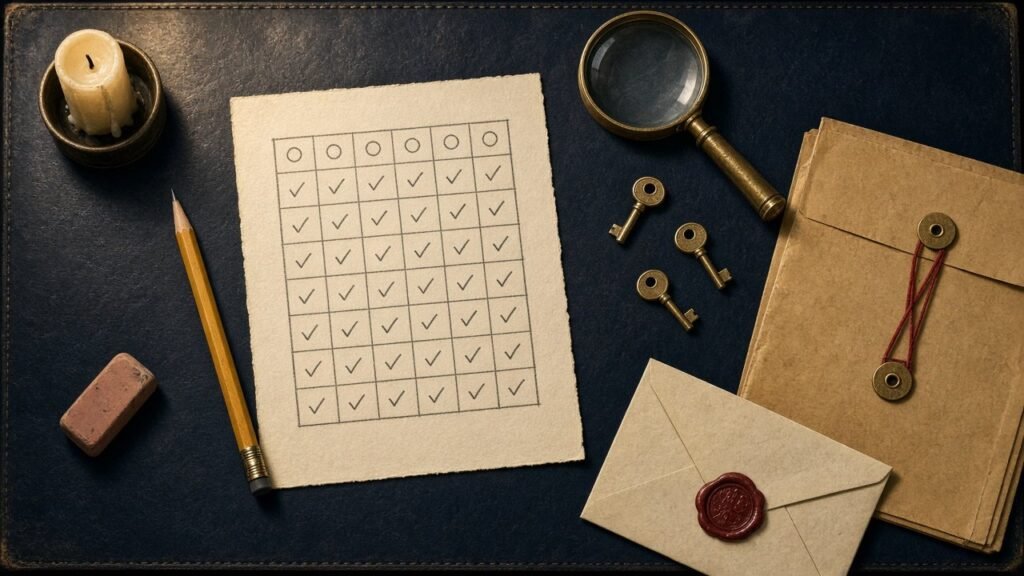
Every great detective started somewhere. Usually with a pencil, a scrap of paper, and the uneasy feeling that the answer was right there all along.
If you have ever looked at a logic puzzle and thought “I wouldn’t know where to begin”, this note is for you. There is no special talent involved, only a handful of habits. I’ll show you each one, and then we’ll use them together on a small practice case I wrote just for this page.
Habit 1: Read every clue twice
The first reading tells you the story. The second tells you the facts. Watch the small words: not, only, directly beside, at least. A puzzle is usually solved or lost on one of those.
Habit 2: Turn every clue into marks
Don’t try to hold the case in your head. Draw a simple grid with the people down the side and the possibilities across the top. Then translate each clue into marks: a ✗ for “definitely not” and a ✓ for “definitely yes”.
Habit 3: One tick clears a whole line
This is the trick that makes grids so powerful. When you place a ✓, everything else in that row and that column becomes a ✗ at once. If Bram was in the cellar, nobody else was, and Bram wasn’t anywhere else.
Habit 4: Chain your clues together
Single clues rarely crack a case. The magic happens when two clues touch. “The key was in the Conservatory” plus “Bram had the letter” quietly tells you something new: Bram was not in the Conservatory. Always ask, “What do these two clues tell me together?”
Habit 5: Look for the last one standing
When a row or column has only one empty square left, that square must be a ✓. Elimination is a detective’s best friend: you don’t always need to prove who did it if you can prove who didn’t.
Habit 6: Pencil, not pen, and mark your guesses
Sometimes you’ll need to try an idea. That’s allowed, but mark guesses differently (a small dot or a circle) so you can rub them out cleanly if they lead nowhere.
Habit 7: Check every clue at the end
Before you name a culprit, go back through every clue and make sure your answer agrees with all of them. A good solution never breaks a single rule.
The practice case: the House of Three Doors
Three guests were found in three different rooms of an old house: the Library, the Conservatory and the Cellar. Each held one thing: a candle, a key or a letter. The guests were Ada, Bram and Cora.
- Whoever held the key was in the Conservatory.
- Bram was holding the letter.
- Whoever was in the Library held the candle.
- Cora was not in the Library.
Someone was hiding in the Cellar. Who? Have a go first, then read on for the walkthrough.
· · ·
Show the walkthrough
Step 1 (clue 2): Bram had the letter. Tick it, and cross out the candle and key for Bram (Habit 3).
Step 2 (clues 1 and 2 together): The key belongs to the Conservatory, and Bram doesn’t have the key, so Bram wasn’t in the Conservatory (Habit 4).
Step 3 (clues 3 and 2 together): The Library goes with the candle, and Bram has the letter, so Bram wasn’t in the Library either.
Step 4 (last one standing): Bram’s only remaining room is the Cellar. Tick it (Habit 5).
| Library | Conservatory | Cellar | |
|---|---|---|---|
| Ada | ? | ? | ✗ |
| Bram | ✗ | ✗ | ✓ |
| Cora | ? | ? | ✗ |
Step 5 (clue 4): Cora wasn’t in the Library, and the Cellar is taken, so Cora was in the Conservatory, holding the key (clue 1). That leaves Ada in the Library with the candle (clue 3).
Step 6 (check every clue): Key in the Conservatory with Cora ✓. Letter with Bram ✓. Candle in the Library with Ada ✓. Cora not in the Library ✓.
The answer: Bram was hiding in the Cellar, letter in hand. What was in that letter is a mystery for another night.
From three guests to a whole guest list
Those same seven habits scale up beautifully. My casebooks are elimination puzzles on a grand scale: instead of three guests you work through an entire registry of records, applying the clues in order until a single name survives. Two extra tips for bigger cases:
- Keep a ledger. Note how many suspects remain after each clue. If a number ever looks wrong, you’ll know exactly where to look back.
- Record the number, not just the name. In a big registry, names can repeat. A detective who writes down only “Smith” is asking for trouble.
And cryptograms?
The habits travel well. Read the coded message twice, mark only what you’re sure of, chain small discoveries together and check everything at the end. Start with the short words: a one-letter word is almost always A or I, and a letter after an apostrophe is often S or T. Then try your new habits on today’s free Daily Cryptogram.
Ready for a real case?
When you’re ready to graduate from three doors to a whole manor house, start with The Missing Guest List. It includes a practice puzzle to warm up on and hints if you get stuck, and you can check your final accusation on the Check Your Accusation page.
Look closer. Think deeper. Find the truth.
— Ivy
Ready for a real case?
Try today’s free Daily Cryptogram, or pick up a casebook.